Florida ESA & Scholarship Programs | FES-EO, FES-UA, FTC

Most parents who qualify for these programs don’t apply, and the reason is almost always the same: they assume they earn too much. Florida removed the income cap in 2023. If your child can enroll in a Florida public school, you can apply.

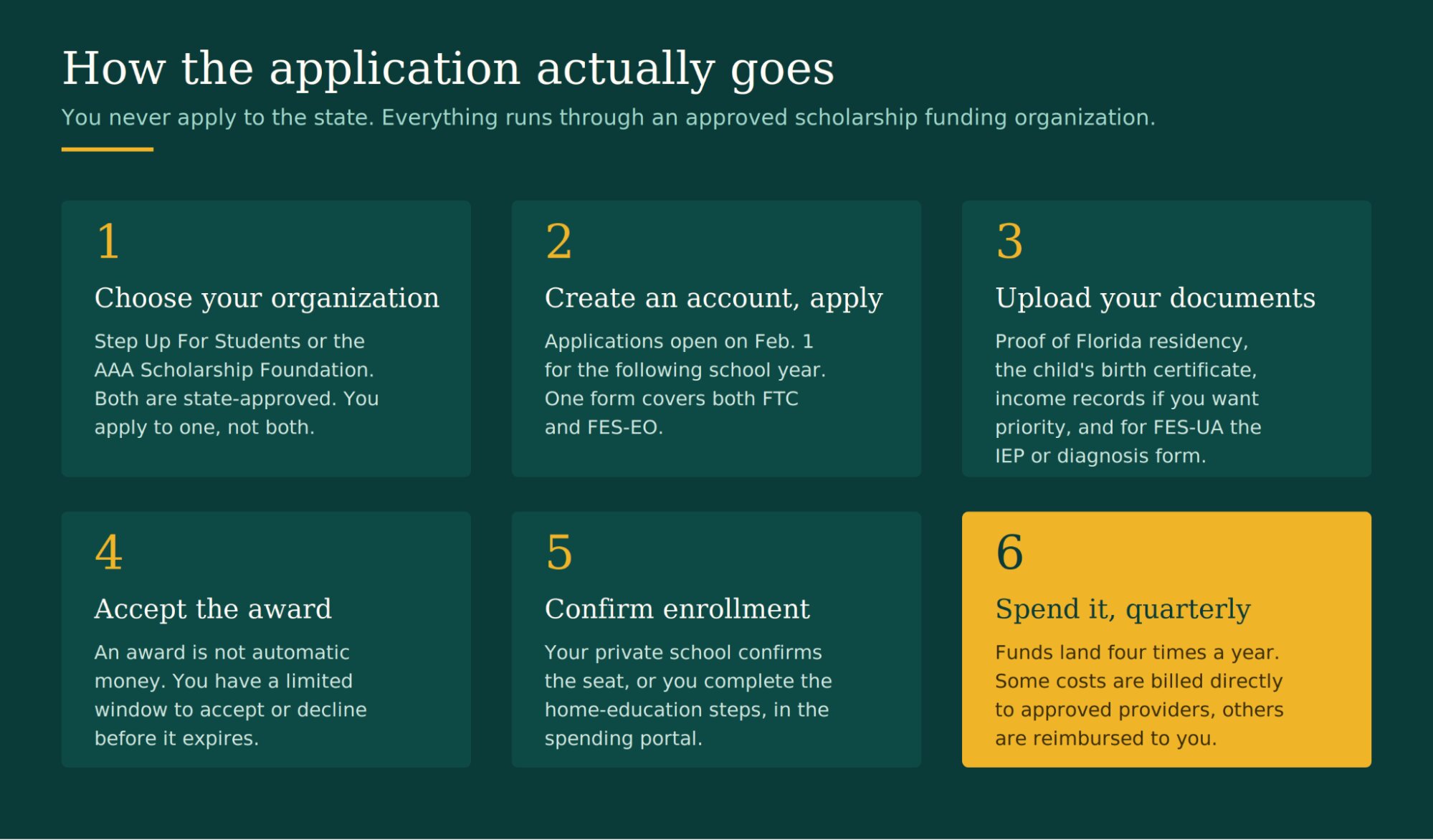
The process is also shorter than it looks. You create an account with one of two organizations, not with the state. You upload proof of Florida residency, your child’s birth certificate, and a tax return if you want to be considered for priority. One form covers both of the main programs, so you are not stuck guessing which to pick. Most families finish it in an evening.

Two things nobody warns you about. An approval email is not the end. You have to actively accept the award or it expires. And the money arrives in four quarterly deposits rather than one lump sum, which matters if you were planning to pay a year of tuition in August. There are four main scholarship programs. Each one works a little differently, and each one is meant for a different type of family. Here is what you need to know.

What Do These Programs Actually Do?

They put education money in your hands instead of sending it straight to a public school. Think of it as a bank account your child’s education money sits in, which you draw from for tuition, tutoring, online classes, curriculum, and in some cases therapy and specialized services.

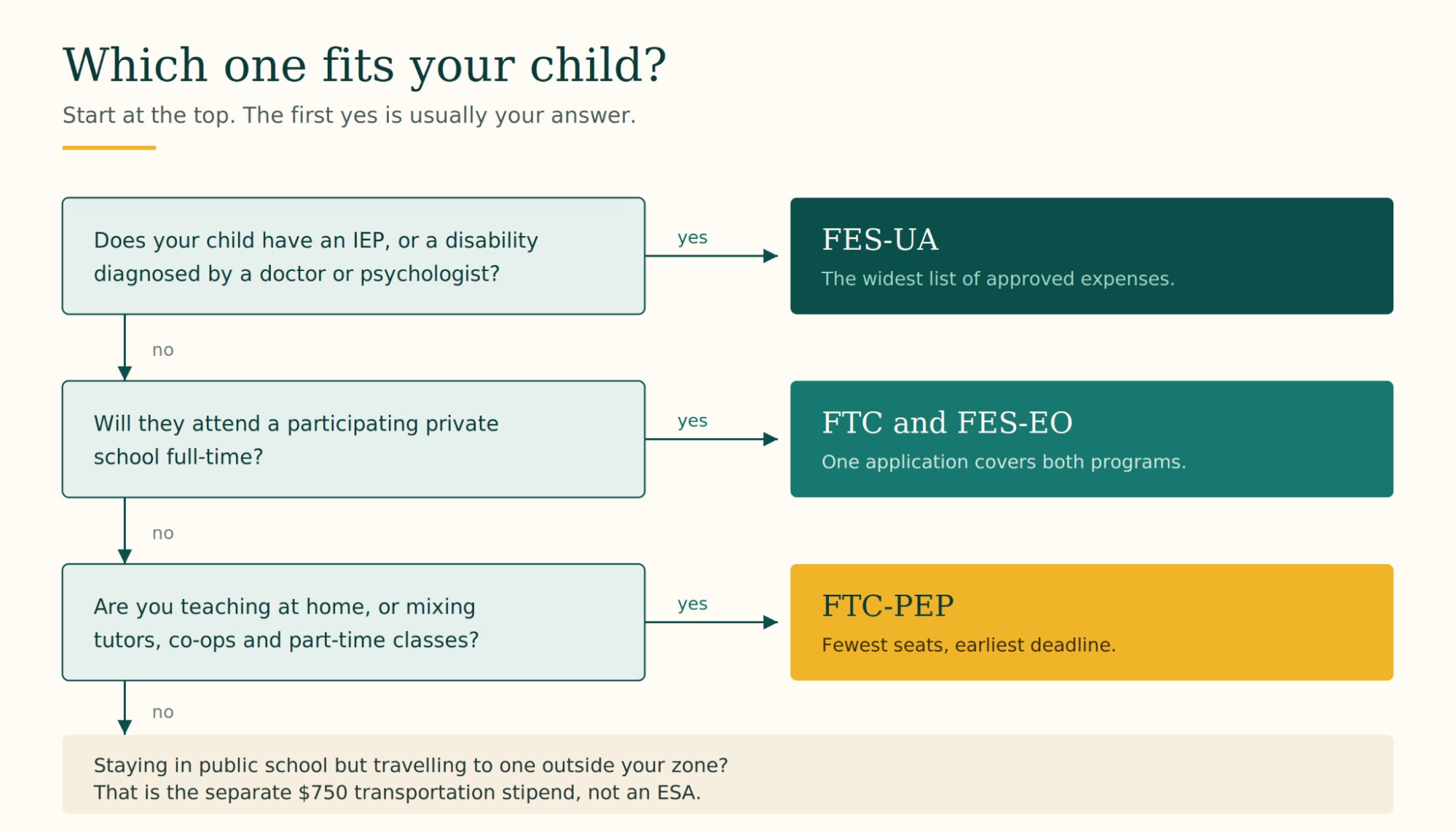
The four programs are the Florida Tax Credit ESA, the Family Empowerment Scholarship for Unique Abilities, the Family Empowerment Scholarship for Educational Options, and the Florida Tax Credit Personalized Education Program. Different names, different rules, different kids they are built for.

What Do These Programs Actually Do

Florida Tax Credit ESA (FTC ESA)

Florida Tax Credit ESA

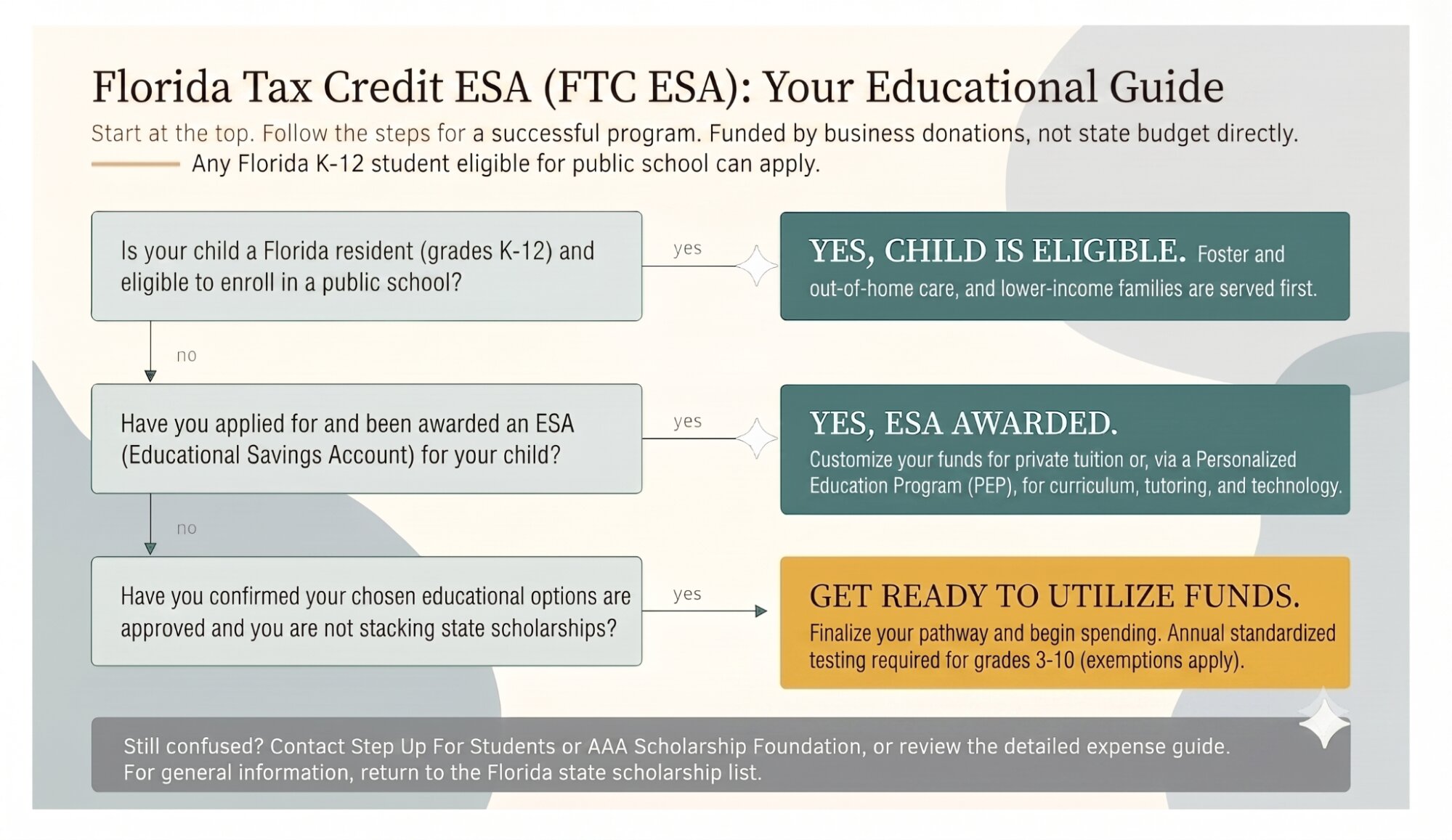
This one does not come from the state budget directly. Businesses donate to a fund and get tax credits in return. That money is then managed by organizations like Step Up For Students and AAA Scholarship Foundation, and families can apply for it through them.

If you want to use it for private school, straightforward enough. If you want to homeschool, you sign up for something called a Personalized Education Program and use the funds for curriculum, tutoring, and online learning instead. Who can apply? If your child is a Florida resident and could enroll in a public school here, you are eligible. There is no income cutoff, so do not rule yourself out. Income only affects where you sit in the queue. Families in foster or out-of-home care and those at the lower end of the income range are served first, then families up to 400% of the federal poverty level.

What can the money go toward? Private school tuition is the obvious one, but the account also covers homeschool expenses, curriculum, tutoring, online courses, learning technology, and testing fees.

Worth knowing: this cannot be combined with another state scholarship, and your child cannot be enrolled full-time in a public or charter school while using it. If your child is in grades 3 through 10, they will need to take an approved standardized test each year, though students with disabilities for whom testing is not appropriate are exempt.

Family Empowerment Scholarship for Unique Abilities (FES-UA)

Florida Education Scholarships

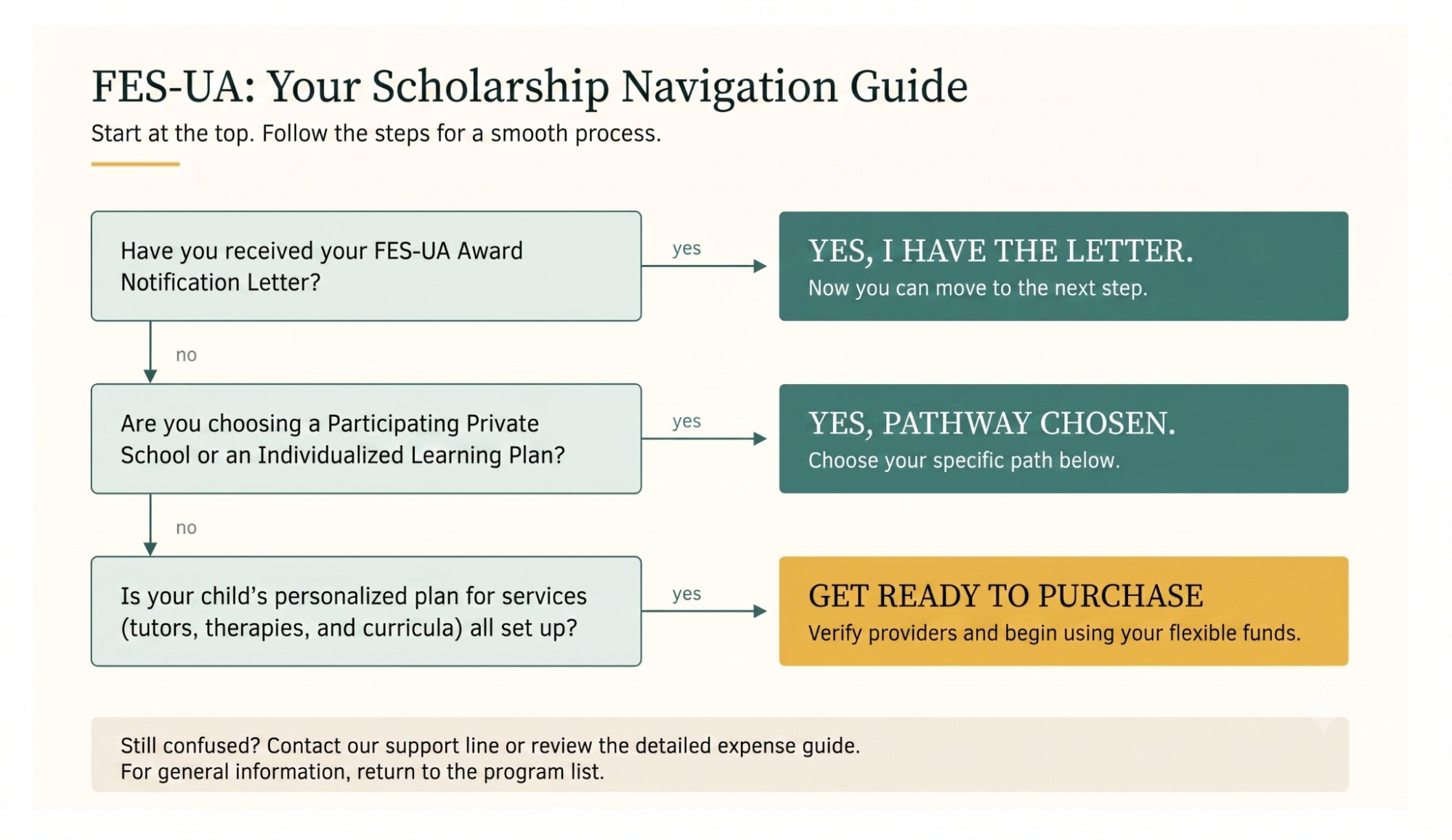
This one is for kids with disabilities. It is probably the most flexible program Florida offers because the list of approved expenses is genuinely broad. Who qualifies? Students aged 3 to 22 with an IEP or a diagnosis from a licensed doctor or psychologist. Qualifying conditions include autism, cerebral palsy, Down syndrome, intellectual disability, spina bifida, muscular dystrophy, speech or language impairments, and certain rare diseases. Kids aged 3 to 5 flagged as high-risk due to developmental delays may also be eligible.

What can you use it for? Private school tuition, therapy services, tutoring, learning materials and devices, online programs, home education costs, testing fees, and contributions to a college savings plan. It is a wide net, which makes it genuinely useful for families dealing with complex learning needs.

Money gets deposited quarterly into the student’s account. The exact amount depends on grade level, which county you live in, and your child’s level of need.

Recommended Reading: Why Two Arizona Families Can Get Very Different ESA Amounts – And How to Know Where Your Child Falls

Family Empowerment Scholarship for Educational Options (FES-EO)

Florida Education Scholarships

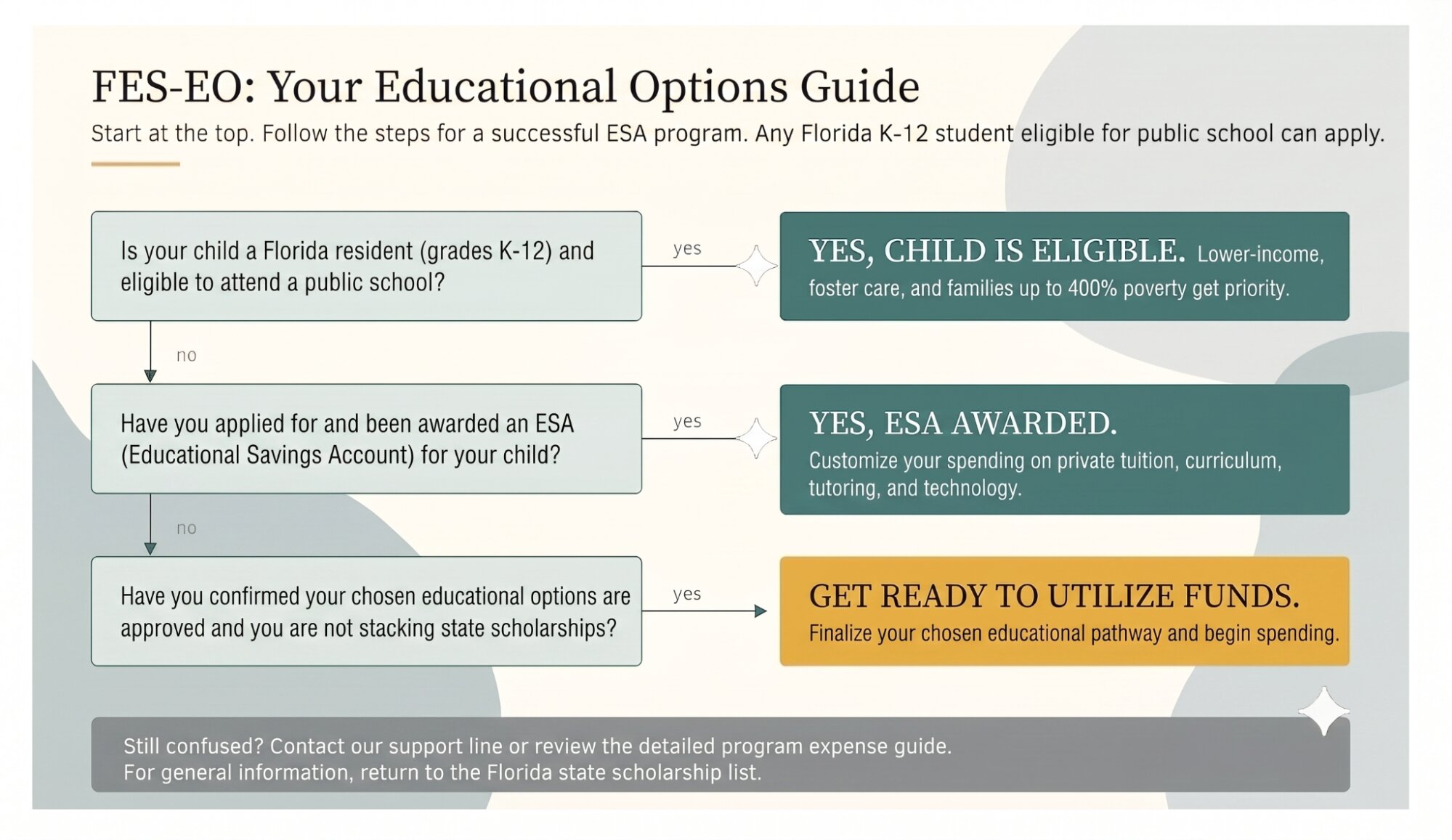
This is the most open program. Any Florida K through 12 student who is eligible for public school can apply. In 2023, it moved to an ESA model, so the money is no longer just for private school tuition. Families now have more flexibility in how they spend it.

Who qualifies? Any Florida resident in grades K through 12 who could otherwise attend a public school. Lower-income families and kids in foster or out-of-home care get priority, then families up to 400% of the federal poverty level.

What can you spend it on? Private school tuition, curriculum, tutoring, testing, online programs, and learning technology.

You cannot stack this with another state scholarship. Public and charter school students are not eligible while enrolled there.

Florida Tax Credit Personalized Education Program (FTC-PEP)

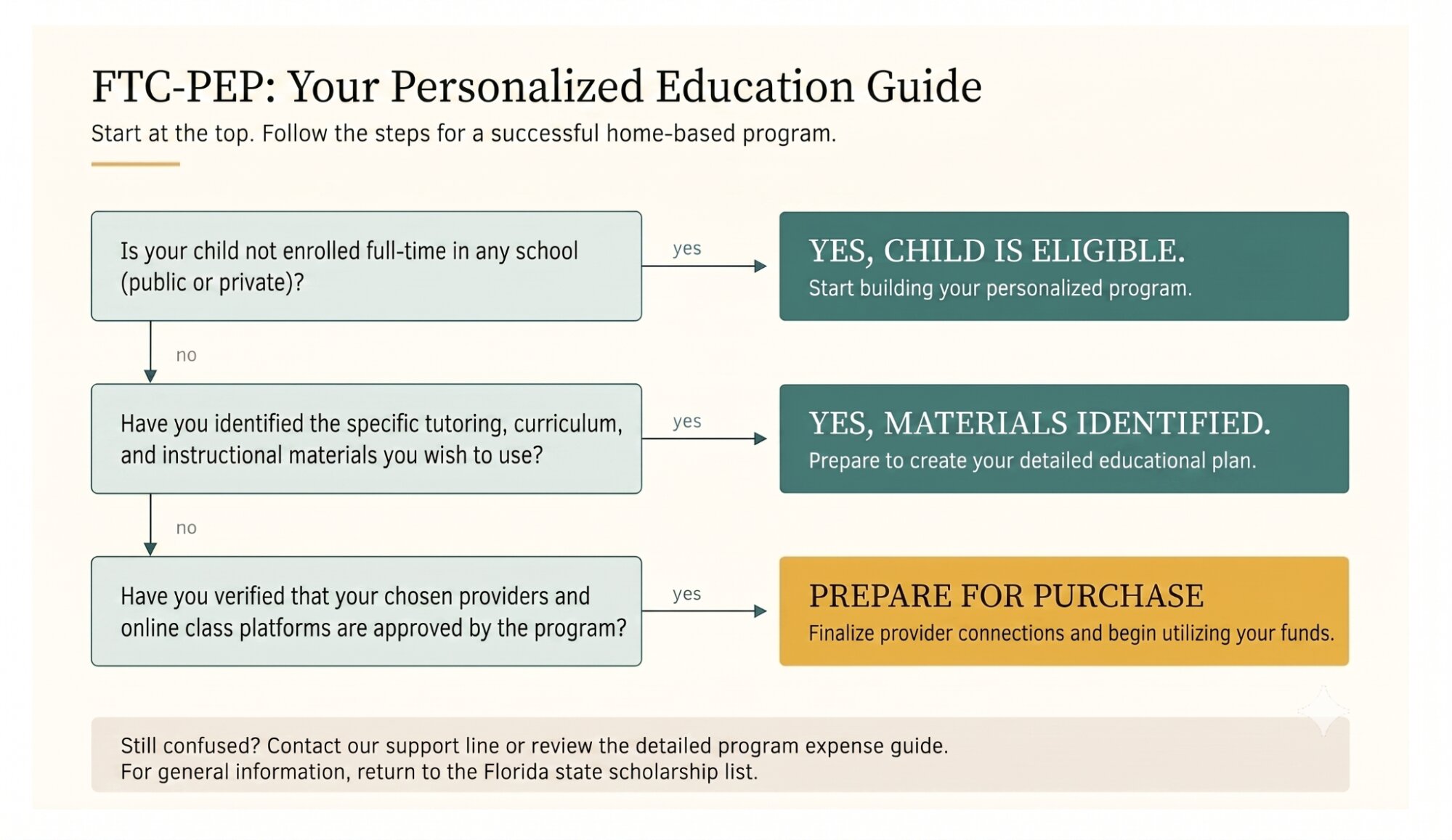
This one is for families whose kids are not enrolled full-time in any school, public or private. It is funded through business tax credits and gives parents direct control over how the money is used at home.

It covers tutoring, curriculum, instructional materials, online classes, and other approved learning tools. If you are already homeschooling or doing something in between, this program was built for you.

What can you spend it on? Private school tuition, curriculum, tutoring, testing, online programs, and learning technology.

You cannot stack this with another state scholarship. Public and charter school students are not eligible while enrolled there.

Can You Use These Funds for Online Classes?

Yes, for the programs that allow flexible spending. You can put your scholarship funds toward live online classes, tutoring, and curriculum across a wide range of subjects, as long as the provider is on your scholarship organization’s approved list.

It is a practical option. Your child gets real instruction without anyone having to rearrange their whole week to make it work.

Questions Parents Usually Ask

Can my child be on two scholarships at once? No. Florida only allows one state scholarship per student at a time.

How long does the money last? Most programs continue until your child finishes high school, ages out, or goes back to public school, whichever happens first. Funds are deposited quarterly, and you reapply each year.

Do I apply through the state? No. You apply through an approved Scholarship Funding Organization like Step Up For Students or the AAA Scholarship Foundation. They handle the process, not the state directly.

Is there an income requirement? It depends on the program. FES-UA is based on a qualifying diagnosis, not income. The others prioritize lower-income families but do not cut people off based on income alone.

Questions Parents Usually Ask

Can my child be on two scholarships at once? No. Florida only allows one state scholarship per student at a time.

How long does the money last? Most programs continue until your child finishes high school, ages out, or goes back to public school, whichever happens first. Funds are deposited quarterly, and you reapply each year.

Do I apply through the state? No. You apply through an approved Scholarship Funding Organization like Step Up For Students or the AAA Scholarship Foundation. They handle the process, not the state directly.

Is there an income requirement? It depends on the program. FES-UA is based on a qualifying diagnosis, not income. The others prioritize lower-income families but do not cut people off based on income alone.

Florida Education Scholarships

Can my child be on two scholarships at once? No. Florida only allows one state scholarship per student at a time.

How long does the money last? Most programs continue until your child finishes high school, ages out, or goes back to public school, whichever happens first. Funds are deposited quarterly, and you reapply each year.

Do I apply through the state? No. You apply through an approved Scholarship Funding Organization like Step Up For Students or the AAA Scholarship Foundation. They handle the process, not the state directly.

Is there an income requirement? It depends on the program. FES-UA is based on a qualifying diagnosis, not income. The others prioritize lower-income families but do not cut people off based on income alone.

Where to Go From Here

Florida gives parents more control than most states do. Whether your child needs extra support, you are thinking about private school, or you are building something at home, there is a real program here that might help.

Once you figure out which scholarship fits, the next step is deciding where to put those funds. For kids who are into tech, love figuring out how things work, or just need something more challenging like advanced math, a robotics or an advanced math program is worth looking into. Step Up For Students funds are eligible for any of these programs. Moonpreneur is on a mission to change how kids learn and prepare them for a world that moves fast.

The post Florida ESA & Scholarship Programs | FES-EO, FES-UA, FTC appeared first on Moonpreneur.

PakarPBN

A Private Blog Network (PBN) is a collection of websites that are controlled by a single individual or organization and used primarily to build backlinks to a “money site” in order to influence its ranking in search engines such as Google. The core idea behind a PBN is based on the importance of backlinks in Google’s ranking algorithm. Since Google views backlinks as signals of authority and trust, some website owners attempt to artificially create these signals through a controlled network of sites.

In a typical PBN setup, the owner acquires expired or aged domains that already have existing authority, backlinks, and history. These domains are rebuilt with new content and hosted separately, often using different IP addresses, hosting providers, themes, and ownership details to make them appear unrelated. Within the content published on these sites, links are strategically placed that point to the main website the owner wants to rank higher. By doing this, the owner attempts to pass link equity (also known as “link juice”) from the PBN sites to the target website.

The purpose of a PBN is to give the impression that the target website is naturally earning links from multiple independent sources. If done effectively, this can temporarily improve keyword rankings, increase organic visibility, and drive more traffic from search results.

Jasa Backlink

Download Anime Batch